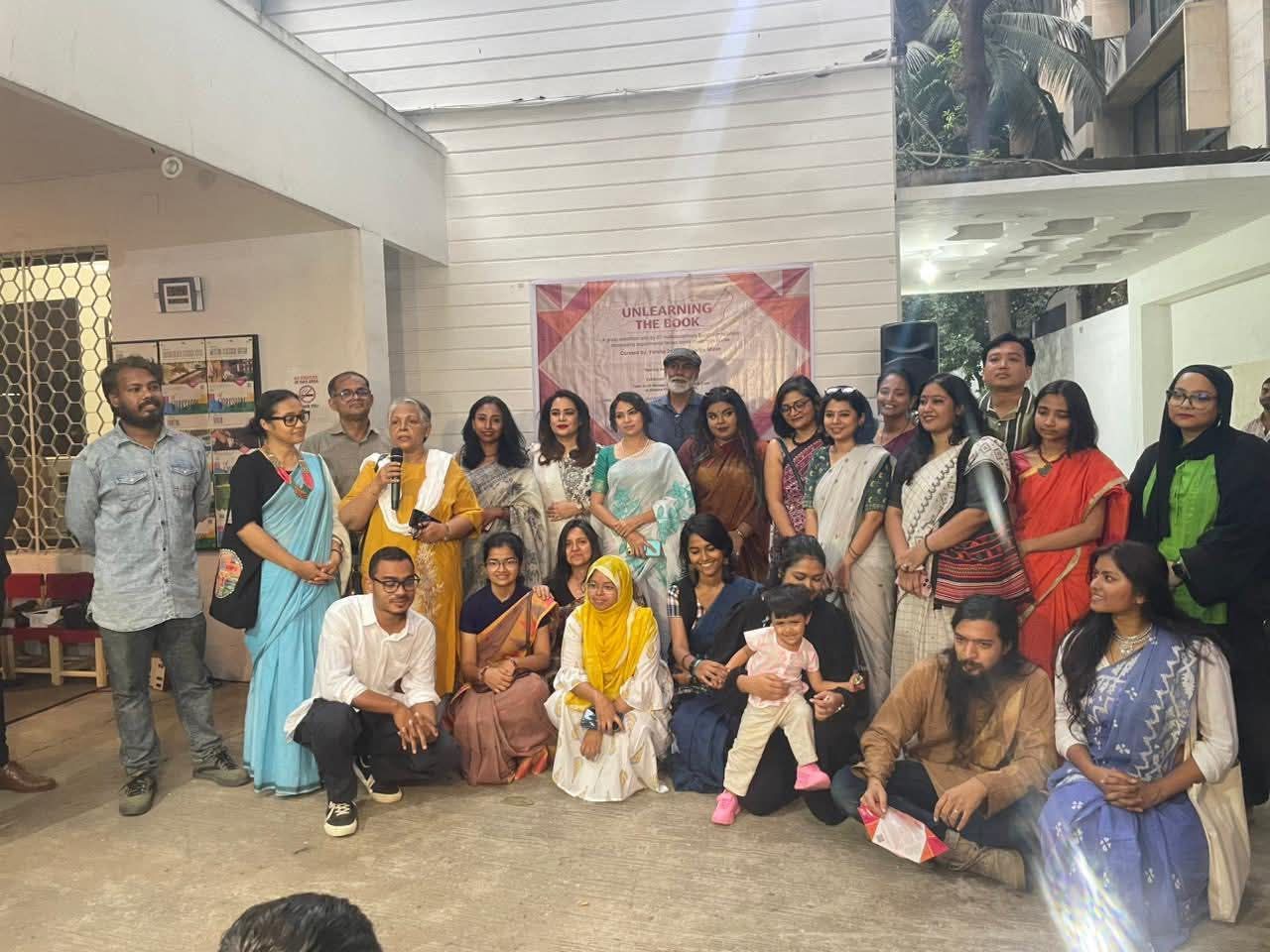
"Unlearning the Book" arrives in Iași, Romania.
The Romania chapter of Unlearning the Book marked the first international expansion of this process-based, collective art initiative, conceived as an evolving travelling exhibition and living archive. Originating in Bangladesh under the curatorial direction of Sadya Mizan and Fareha Zeba.
The project travelled to Iași, Romania, where it was curated by Sadya Mizan and brought together 25 Bangladeshi and 26 Romanian artists to explore storytelling, memory, identity and cultural heritage through experimental interpretations of the book.
The Iași chapter was realised through multilayered partnerships and collaborations involving Alexandru Ioan Cuza University, through its Faculty of Psychology and Education Sciences and the Erasmus mobility exchange programme; the National Museum Complex “Moldova” Iași, through the Poni–Cernătescu Museum; George Enescu National University of Arts (UNAGE); STUDIO_PORTALS@ARMEANĂ.18; Negru Zi – Coffee & Arts; and Uronto Artist Community. The organising and collaborating team included Andrei-Claudiu Timofte, Dan-Mihail Acostioaei, Ioana Palamar, Monica Nănescu, Ovidiu Gavrilovici and Tudor Pătraşcu, whose collective contributions supported the development, coordination and public engagement of the chapter.
Collaborative Approach and Artistic Participation
The project invited Romanian artists through an open call for participation. This brought together students from the textile and painting departments of George Enescu National University of Arts alongside a substantial number of independent practitioners based across Romania. Participants represented diverse professional and creative backgrounds, including visual arts, theatre, community work, psychotherapy, chemistry, research and ceramics. This diversity encouraged interdisciplinary exchange and expanded the project's perspectives beyond conventional artistic education and practice.
Alongside newly developed textile-based and experimental artworks, students from UNAGE's Mural Art Department were invited to contribute previously created paper-based and printed experimental books. Although textile remained the central medium of the project, these works offered another interpretation of unlearning conventional bookmaking and linear storytelling, demonstrating how existing artistic practices could connect with the project's wider conceptual inquiry.
Due to the volume and diversity of participating works, the exhibition was distributed across two complementary venues. The first exhibition opened on 27 May 2026 at STUDIO_PORTALS@ARMEANĂ.18, presenting the majority of Bangladeshi artworks alongside a diverse selection of Romanian contributions. The second opened on 28 May at the Hall of the Echoing Footsteps, Alexandru Ioan Cuza University, featuring experimental works by Romanian artists. Both exhibitions continued until 4 June 2026.
The artworks explored personal histories, collective memory, migration, ecology, mythology, identity, care and social narratives through textile, embroidery, recycled materials, sound, performance and interactive storytelling. Textile upcycling and the use of reclaimed materials also encouraged sustainable creative practices.
Public Engagement and Conceptual Workshops
The programme began with a peer-learning workshop at the Poni–Cernătescu Museum on 14 May, followed by a public lecture-performance and conversation by Sadya Mizan at Negru Zi Café on 26 May. The presentation introduced the project's journey, research questions and curatorial methodologies, setting the conceptual tone for the exhibitions.
Alongside the exhibitions, 14 scheduled public activity sessions across three programme days were organised at different venues, complemented by guided tours, artist conversations and collaborative exchanges. Each activity was conceptually connected to the project's central inquiry: how stories can be created, represented, preserved, shared and experienced beyond the conventional book.
The cyanotype workshop, conducted at the Poni–Cernătescu Museum by museographer Oana Florescu, connected chemistry, science, heritage and artistic experimentation within the setting of a historic chemistry laboratory. Zine-making workshops, arranged at both the museum and STUDIO_PORTALS, explored accessible self-publishing, personal archives and collective storytelling.
The Henna Narrative sessions invited participants to consider what stories they would choose to carry on their skin, using temporary body art as a medium of cultural and personal expression. Threads and Thoughts, drawing on sashiko-inspired stitching and embroidery, encouraged participants to slow down, reflect, repurpose materials and weave memories into textiles.
The Miniature Graffiti Workshop introduced an interactive bookmaking process through public contributions to a collective graffiti book, while a tarot and symbolism session explored personal narratives through symbolic interpretation and the idea of a book of life. Each activity offered a different approach to unlearning familiar methods of storytelling, from individual expression to collective authorship and from temporary marks to material archives.
Shared Ownership and Cross-Cultural Exchange
The programme extended across an independent artist studio, a university exhibition hall, a museum and a community café, allowing different audiences to encounter and contribute to the project. Regular guided tours, interactive installations and open public activities encouraged visitors to touch, unfold, interpret, play and spend time with the artworks rather than simply observe them.
Online artist story-reading sessions connected Bangladeshi artists with Romanian artists and audiences, creating opportunities to share the stories, research and creative processes behind the exhibited works across geographical and linguistic boundaries.
The chapter demonstrated how an exhibition can become a shared learning environment rather than a fixed presentation of finished artworks. Its collaborative structure allowed artistic contributions, public participation and institutional partnerships to collectively shape the experience, encouraging a sense of shared ownership.
The Romania chapter concluded its exhibitions on 4 June 2026, carrying forward new artworks, relationships, experiences and narratives into the project's evolving living archive. Beyond expanding the conventional idea of a book, Unlearning the Book deliberately embraces textiles for their deep-rooted connection to storytelling, memory and cultural expression across societies. Through reusing and repurposing fabrics, the project encourages thoughtful and sustainable artistic practices, transforming familiar materials into meaningful archives of stories that might otherwise remain untold. These textile narratives create space to explore resilience, identity, gender, personal freedom and collective memory, offering alternative ways to preserve and share experiences. Each chapter adds new voices and perspectives, allowing the project to continue evolving as a collective archive of lived experiences, cultural knowledge and human connections.